Comparison
Jeep Wrangler JK vs JL: What Changed in 2018
Side-by-side factory data for the 2018 Wrangler JK and JL: engines, transmissions, size, weight, towing, oil and coolant capacity, lug torque and service schedules.
By the Southeast CDJR editorsUpdated November 8, 20268 min read
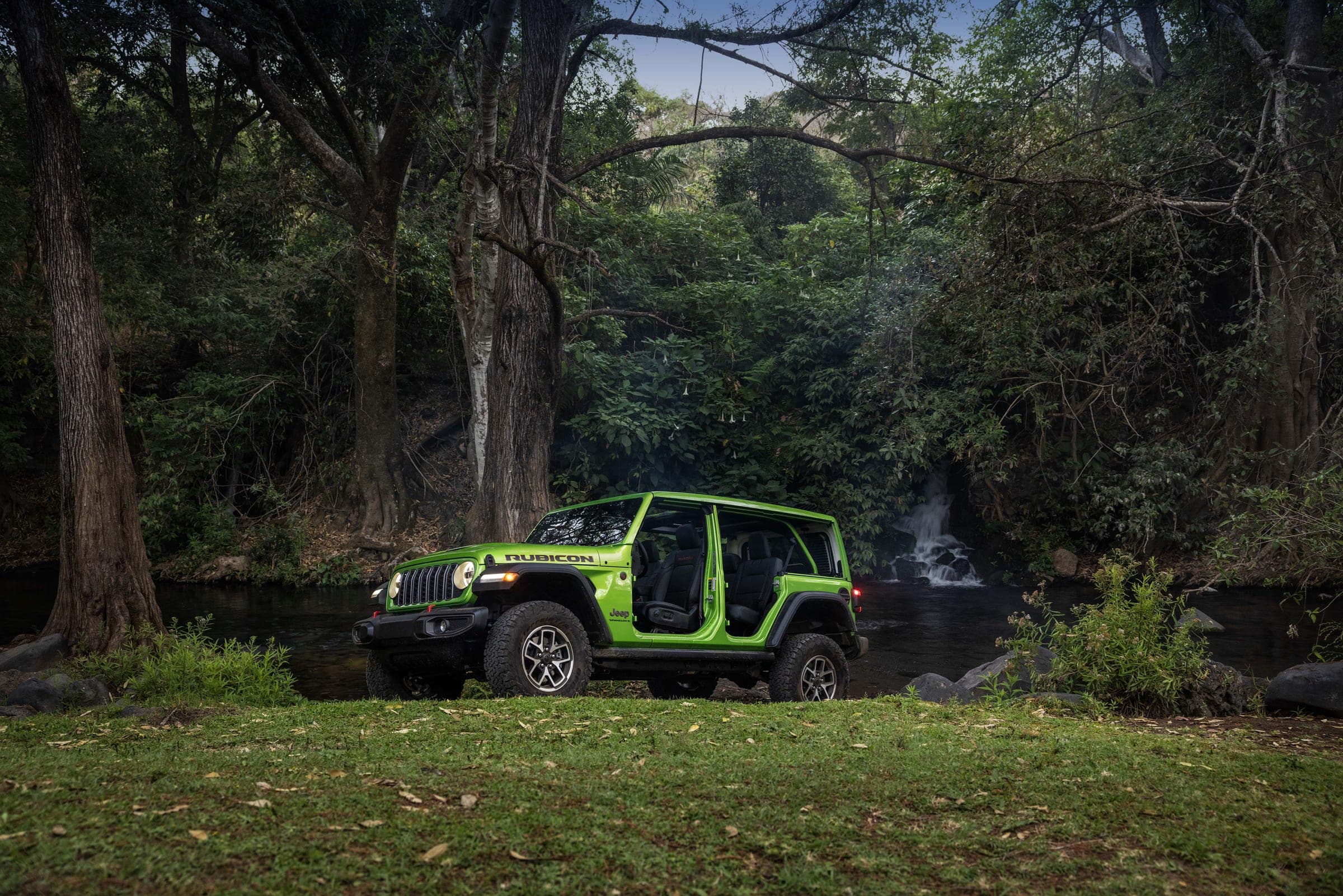
Model year 2018 is the one year when you could buy two different Wranglers. The carryover JK, which the spec sheet dates to 2007, finished its run, and the all-new JL arrived alongside it. The research data keeps them apart as separate vehicles, labelled "Wrangler JK" and "Wrangler JL" in the 2018 data, and the differences go well past styling: a new turbo engine, an eight-speed automatic, a longer wheelbase, a smaller oil fill, and lug nuts that need 30 more ft‑lb.
Short answers for the searches that bring most people here. JL engine oil takes 5 quarts with filter, against 6 quarts on the JK. The V6 makes the same 285 hp and 260 lb‑ft in both. Both list 3,500 lb as the top trailer rating on a four-door, but the JK only gets there with the 3.73 or 4.10 axle. Everything below comes from the manufacturer spec sheets and owner's manual tables loaded into our research database, and I note where those two sources disagree.
Engines and transmissions
The 3.6‑liter Pentastar V6 carries over unchanged on paper. The JL adds a 2.0‑liter turbo four, which the sheet lists as available on all models.
| 2018 | JK | JL |
|---|---|---|
| 3.6L V6 power / torque | 285 hp at 6,400 rpm / 260 lb‑ft at 4,800 rpm | 285 hp at 6,400 rpm / 260 lb‑ft at 4,800 rpm |
| 3.6L compression ratio | 10.2:1 | 11.3:1 |
| 2.0L turbo four | Not offered | 270 hp at 5,250 rpm / 295 lb‑ft at 3,000 rpm |
| Manual | 6‑speed NSG 370 (standard) | 6‑speed D478 (3.6L only) |
| Automatic | 5‑speed W5A580 (optional) | 8‑speed 850RE (standard with 2.0L, optional with 3.6L) |
| First gear, automatic | 3.59 | 4.71 |
| Transfer cases | Command-Trac 2.72:1 low; Rock‑Trac 4.0:1 low (Rubicon) | Same two, plus optional full-time Selec‑Trac on Sahara |
For the V6 the EPA figures on the 2018 sheets (city/highway/combined) are 17/21/18 for the JK two-door automatic and 16/21/18 for the four-door automatic. The JL V6 is listed at 18/23/20 with the automatic and 17/23/19 with the manual, with no door split. The 2018 JL sheet shows "TBD" for the turbo four, and the 2019 sheet fills it in at 23/25/24 (two-door automatic) and 22/24/22 (four-door automatic). See the 2019 Wrangler page for the rest of that year.
Size and weight
The JL is longer in the wheelbase, a little taller and, on the same trim, heavier. All numbers are inches.
| JK two-door | JL two-door | JK four-door | JL four-door | |
|---|---|---|---|---|
| Wheelbase | 95.4 | 96.8 | 116 | 118.4 |
| Length with spare | 164.3 | 166.8 | 184.9 | 188.4 |
Width is 73.7 on the JK and 73.8 on the JL, and height is 72.6 against 73.6. Turning diameter is where the JL gains: the JK sheet lists one figure of 40.8 ft, while the JL lists 34.5 ft for the two-door and 39.4 ft for the four-door.
Curb weights in the JK's 2018 sheet match the 2017 four-door (Unlimited) sheet exactly, so I compare them with the JL's four-door figure. These are the 3.6L with an automatic:
| Trim | JK curb weight, lb | JL curb weight, lb | Difference, lb |
|---|---|---|---|
| Sport | 4,100 | 4,200 | +100 |
| Sahara | 4,294 | 4,345 | +51 |
| Rubicon | 4,340 | 4,455 | +115 |
The JL's 2.0‑liter versions run heavier still: 4,320 lb for a four-door Sport and 4,485 lb for a four-door Rubicon, both with the automatic.
Ground clearance and angles
Each sheet lists clearance by tire. The standard tire on each trim is compared here. The JL Rubicon approach angle is 44 degrees on the two-door and 43.9 on the four-door.
| Trim and tire | Ground clearance, in | Approach angle, degrees |
|---|---|---|
| JK Sport, P225/75R16 | 8.2 | 38.5 |
| JL Sport, 245/75R17 | 9.7 | 41.4 |
| JK Sahara, P255/70R18 | 9.7 | 41.7 |
| JL Sahara, 255/70R18 | 10 | 41.8 |
| JK Rubicon, LT255/75R17 | 10 | 42.2 |
| JL Rubicon, LT285/70R17 | 10.8 | 44 (2‑door), 43.9 (4‑door) |
The Sport changed the most, because the JL's standard tire is bigger than the JK's standard 16‑inch tire.
Towing: where the axle ratio matters
Both generations list a top trailer rating of 3,500 lb for a four-door. Reaching it is different. The JK sheet gives a pair of ratings for the Sport and Sahara: 2,000 lb with the 3.21 axle and 3,500 lb with the 3.73. The Rubicon, with its 4.10 axle, is 3,500 lb in every row. The JL four-door rows all say 3,500 lb for the 3.6L and the 2.0L, with a 3.45 axle on Sport and Sahara and 4.10 on Rubicon. The JL engine sections give 2,000 lb for the two-door and 3,500 lb for the four-door. The JK sheet's tow tables cover the four-door only.
| Four-door, 2018 | JK max trailer | JL max trailer | Payload (both) |
|---|---|---|---|
| Sport | 2,000 lb (3.21 axle) or 3,500 lb (3.73 axle) | 3,500 lb | 1,000 lb |
| Sahara | 2,000 lb (3.21 axle) or 3,500 lb (3.73 axle) | 3,500 lb | 880 lb |
| Rubicon | 3,500 lb | 3,500 lb | 892 lb |
The sheets give the same payload figures for JK and JL. They differ in gross combined weight (GCWR): JK ratings run from 6,427 lb to 8,185 lb across these rows, while the JL lists 8,117 lb on the Sport, 10,836 lb on the Sahara and 11,063 lb on the Rubicon. A bigger GCWR is not the same as a bigger trailer rating, since the trailer limit is 3,500 lb either way. For model years 2020 and later the database has a dedicated tow-configuration table; the 2020 Wrangler page and the towing guide show those.
Oil, coolant and fuel
This is where JK owners moving to a JL, or the reverse, get caught.
| 2018, capacities and fluids | JK | JL |
|---|---|---|
| Engine oil with filter | 6 qt (5.6 L), 3.6L | 5 qt (4.73 L), both engines |
| Oil grade | API-certified SAE 5W‑20, MS‑6395 | 3.6L: SAE 0W‑20, MS‑6395. 2.0L: SAE 5W‑30 full synthetic, API SN PLUS, MS‑13340 |
| Cooling system (owner's manual) | 10.5 qt (9.9 L) | 3.6L: 11.2 qt (10.6 L). 2.0L: 10.3 qt (9.7 L) |
| Cooling system (spec sheet) | 14 quarts | 3.6L: 10 quarts. 2.0L: 9.9 quarts |
| Fuel tank | 18.6 gal two-door, 22.5 gal four-door | 18.5/17.5 gal two-door, 21.5 gal four-door |
| Fuel | 87 octane, up to E15 | 87 octane, up to E15; 91 recommended on the 2.0L for best performance |
| Lug nuts | 100 ft‑lb, 1/2" x 20, 19 mm socket | 130 ft‑lb, M14 x 1.50, 22 mm socket |
Two caveats. First, the coolant capacity depends on which source you open: the owner's manual and the spec sheet give different numbers for both generations, so do not treat either as final without checking the manual for your own vehicle. Second, the two-door JL fuel tank is printed as "18.5/17.5 gal" in the manual table and 18.5 on the spec sheet; the 2019 manual table lists 17.5.
The JL also adds a separate cooling loop for its battery and, where fitted, motor generator unit. The manual lists 2.5 qt of battery coolant on both engines, 1.9 qt for the 3.6L motor generator unit, and intercooler loops of 3.2 qt without and 3.5 qt with the motor generator unit on the 2.0L.
Other fluids that changed
| Component | JK | JL |
|---|---|---|
| Automatic transmission | ATF+4 | ZF 8 and 9 speed ATF or equivalent |
| Manual transmission | Manual transmission lubricant, MS‑9224 | ATF+4 |
| Front and rear axles | SAE 80W‑90, API GL-5; SAE 75W-140 synthetic for rear when towing | SAE 75W85, API GL-5 |
| Power steering | Power steering fluid +4 or ATF+4 | Electric steering pump fluid |
| Brake fluid | DOT 3 | DOT 3 |
| Coolant | OAT, MS.90032 | OAT, MS.90032 |
The JK's brake fluid line also allows DOT 4 if DOT 3 is unavailable; the JL line allows the same in 2018. By 2019 the JL listing shows DOT 3 only and splits the rear axle: SAE 75W-140 for the M200 axle and SAE 75W‑85 for the M220, with a friction modifier needed with Trac‑Lok.
Maintenance schedules
The two 2018 schedules in the research data list nearly the same services: inspecting CV and universal joints, brake linings and suspension every 20,000 miles, replacing the cabin air filter every 20,000, an engine air filter at 30,000‑mile steps, and spark plugs and the PCV check at 100,000 miles. The JK schedule runs to 150,000 miles and the JL's stops at 140,000, so the rows at 150,000 (the second coolant flush, the transfer case inspection, the air filter and the manual transmission fluid) show up only for the JK. That reads as a gap in the printed 2018 JL schedule rather than a design difference, since the 2019 schedule below runs to 150,000.
The 2019 schedule fills it in: it runs to 150,000 and lists spark plugs for the 2.0L at 60,000 and 120,000 miles, against 100,000 for the 3.6L. The 2018 JL schedule has only the single 100,000‑mile row. The research data has no oil change interval row for either generation, so check your manual for that. The 2018 Wrangler page has both schedules with a highlight for your odometer reading.
What stayed the same
Both were built at Toledo and both use the same trim ladder of Sport, Sahara and Rubicon. The V6 output, the 87-octane requirement and the two transfer-case ratios carry across. The 2017 data for the JK matches the 2018 JK on oil (6 qt of 5W‑20) and lug torque (100 ft‑lb), as the 2017 Wrangler page shows. The 2019 data matches the JL on 5 quarts and 130 ft‑lb.
How to check your own vehicle
If you are not sure which generation a 2018 truck is, three entries in the data tell them apart: oil capacity (6 vs 5 qt), lug thread (1/2" x 20 vs M14 x 1.50) and automatic (five or eight speeds). The VIN decoder reads the build sheet for a specific truck, and the spec explorer lets you load either generation by year. The Wrangler hub lists every model year in the data, 2015 to 2027.